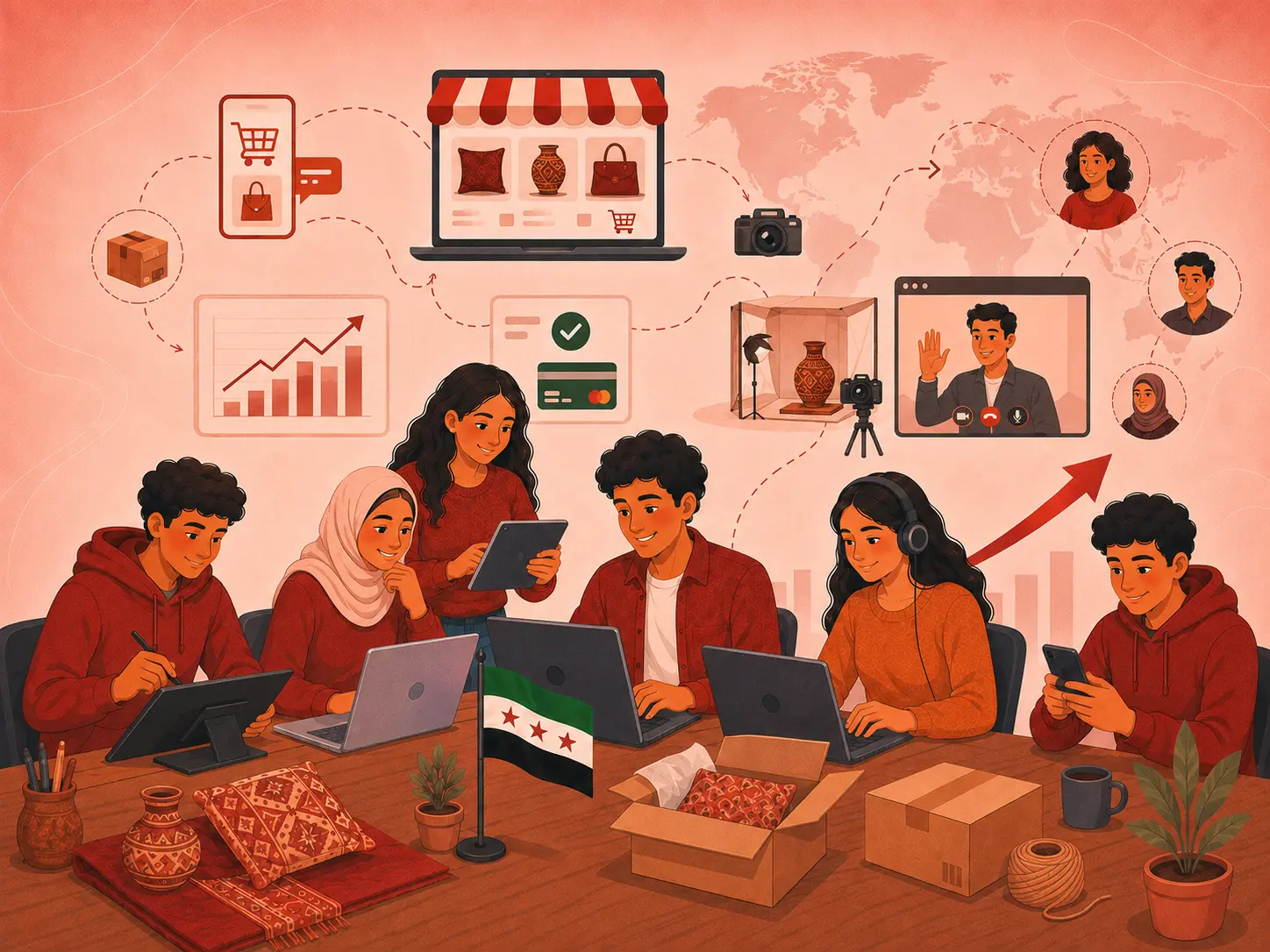
Starting a business rarely fails for lack of a good idea. For displaced entrepreneurs across Lebanon, Jordan, Türkiye, and now Syria itself, it more often fails for lack of capital. Banks hesitate over undocumented credit histories. Landlords and suppliers ask for guarantees that displaced founders cannot provide. Even a strong business plan cannot buy inventory, pay staff, or rent a workspace on its own.
The encouraging news is that a global funding ecosystem built specifically for refugee entrepreneurs has grown steadily over the past decade, spanning character-based microloans, seed grants, accelerator programs, and impact investment funds. At Jusoor, we see the results of this ecosystem daily through our own Entrepreneurship Program, which has trained more than 2,000 entrepreneurs and helped mobilize more than $27 million in support for Syrian-led businesses and startups.
This guide walks through where that capital comes from today, and how founders can position themselves to reach it.
Key Insights
- Only 3% of refugee and migrant entrepreneurs currently access formal business loans, according to the International Finance Corporation.
- Microfinance institutions such as Kiva report refugee loan repayment rates above 95%, on par with non-refugee borrowers.
- Non-dilutive grants and seed funding, including our own $10,000 pre-seed grants, remain among the most accessible early-stage options.
- Impact investors increasingly apply a "refugee lens" to identify investable, refugee-led ventures worldwide.
- Structured investment readiness training measurably improves a founder's ability to raise and manage capital.
Why Access to Capital Remains the Biggest Barrier
More than 117 million people worldwide are forcibly displaced, according to the World Bank, and most live in countries where formal financial systems were never designed with them in mind. That mismatch shows up directly in lending data. Only 3% of refugee and migrant entrepreneurs access business loans, a gap the International Finance Corporation calls the clearest indicator of the global refugee business finance shortfall.
Our own research into the impact of COVID-19 on Syrian-led small businesses in Jordan found similar patterns closer to home. Founders without a local credit history struggled to open bank accounts, could not meet collateral requirements, and were frequently excluded from loan products designed for citizens. Many turned to informal financing from family and diaspora networks, real capital, but rarely enough to grow a business past survival.
This is precisely the gap our Entrepreneurship Program was built to close, pairing access to finance with the mentorship and market knowledge founders need to use that capital well.
Microfinance and Character-Based Lending
For many displaced founders, microfinance is the first realistic entry point into formal capital. Kiva, a nonprofit crowdfunding platform, pioneered character-based lending that evaluates a borrower's business plan and community standing rather than requiring a credit history or collateral. Through its Refugee Investment Fund, Kiva has deployed tens of millions of dollars to displaced borrowers worldwide while maintaining repayment rates above 95%, comparable to conventional microfinance clients.
Regional microfinance institutions in Jordan and Lebanon extend similar character-based products to Syrian founders, often serving as a bridge between informal borrowing and the larger grants and investment described below. For most refugee entrepreneurs, microfinance is not the final destination, but it is frequently the first step that proves a business is viable.
Grants, Seed Funding, and Accelerator Programs
Grants remain one of the most valuable funding sources for refugee entrepreneurs because they do not require repayment or equity. Through our Entrepreneurship Program, we combine training with direct funding across several projects. Our Small Business Accelerator pairs Syrian and Jordanian founders with mentorship, market access, and pathways to finance. Our Startup Roadshow equips early-stage founders to pitch for cash prizes at Demo Day, and our Disruptors project awards seed prizes to promising tech startups ready to scale.
Our Championing Women in Business Leadership project pairs women-led startups with more than 32 hours of leadership training alongside $10,000 pre-seed grants, while Scale Beyond connects investment-ready, Jordan-based startups with growth capital and strategic partners. We also deliver funding through our STEP program partnership with the Islamic Development Bank, which supports skills training and entrepreneurship for displaced and vulnerable communities.
Impact Investors and Diaspora Capital
Beyond grants and loans, a growing number of impact investors are applying what the Refugee Investment Network calls a "refugee lens," directing capital toward six categories of enterprise, including businesses owned by refugees, businesses that hire refugees, and funds that support both. This approach has already helped connect Jordan-based startups with international investors seeking both financial and social returns.
Diaspora capital plays a similar role. Jusoor itself was founded in 2011 by members of the Syrian diaspora, and that same network of successful entrepreneurs, executives, and investors now mentors and funds a new generation of founders. Inside Syria, our Bridges to Syria initiative extends this work through Launchpad, an investment readiness residency that prepares Syrian startups to meet investors and accelerators in leading regional capitals as the country's private sector rebuilds.
Building Investment Readiness: What Funders Look For
Capital rarely flows to a good idea alone. Funders look for founders who understand their numbers, can defend a growth plan, and have already tested their product with real customers. Pairing finance with capacity building improves both outcomes: the International Trade Centre recommends combining loans and grants with coaching in financial literacy and negotiation to improve repayment and long-term growth.
We measure this directly through our Investment Readiness Score, tracked before and after each cohort. In our Championing Women in Business Leadership project, participating founders raised their scores by 13.71% on average, alongside an 18.52% increase in the number of team members their businesses could financially support. For any founder preparing to approach a lender or investor, that same discipline, clean records, a tested product, and a clear growth plan are often the difference between a rejected application and a funded one.
Frequently Asked Questions
What funding options exist for refugee entrepreneurs?
Refugee entrepreneurs can access several types of capital, including character-based microloans from lenders such as Kiva, non-dilutive grants and seed funding from NGOs and accelerator programs, and equity or blended finance from impact investors applying a refugee lens. Diaspora networks also provide informal capital and mentorship.
Can refugee entrepreneurs get business loans without collateral?
Traditional banks typically require collateral and a documented credit history, which many displaced founders do not have. Character-based microfinance institutions such as Kiva instead evaluate a borrower's business plan and community standing, extending loans without requiring conventional collateral.
What is refugee-lens investing?
Refugee-lens investing, pioneered by organizations such as the Refugee Investment Network, directs private capital toward businesses owned or led by refugees, businesses that hire refugees, and enterprises serving displaced communities. It follows a model similar to gender-lens investing.
How much funding can Syrian entrepreneurs receive through Jusoor's Entrepreneurship Program?
Funding varies by project and cohort. For example, our Championing Women in Business Leadership project provides $10,000 pre-seed grants, while our Disruptors project awards seed prizes to top-performing startups at Demo Day. Our entrepreneurship programs are open to Syrians and Palestinians from Syria based in Lebanon, Jordan, Syria, and across the diaspora.
What is investment readiness and why does it matter?
Investment readiness measures how prepared a founder is to receive outside capital, covering financial management, pitching, and growth planning. Participants in our Championing Women in Business Leadership project raised their Investment Readiness Scores by 13.71% on average, improving their ability to secure follow-on funding.
How can I support refugee entrepreneurs through Jusoor?
You can donate to fund grants and mentorship, get involved as a mentor or expert volunteer, or reach out to our Entrepreneurship Program to explore a partnership.
Conclusion
Access to capital is rarely a single transaction. It is a path that usually starts with a small, character-based loan, grows through grants and accelerator support, and eventually opens the door to impact investment and diaspora capital. Displaced entrepreneurs bring the talent, resilience, and market knowledge that this path requires. What has been missing is not ability, but access.
At Jusoor, we build that access every day through our Entrepreneurship Program, and the founders behind projects like Startup Roadshow, Disruptors, and Scale Beyond are proof of what happens when capital finally reaches talent. If you would like to help us close this gap, donate to fund the next cohort of grants, or get involved as a mentor to a founder building their business from the ground up. For more on what it takes to build and scale a business in the region, read our related guides on scaling a small business in the Levant and starting a small business in Syria.