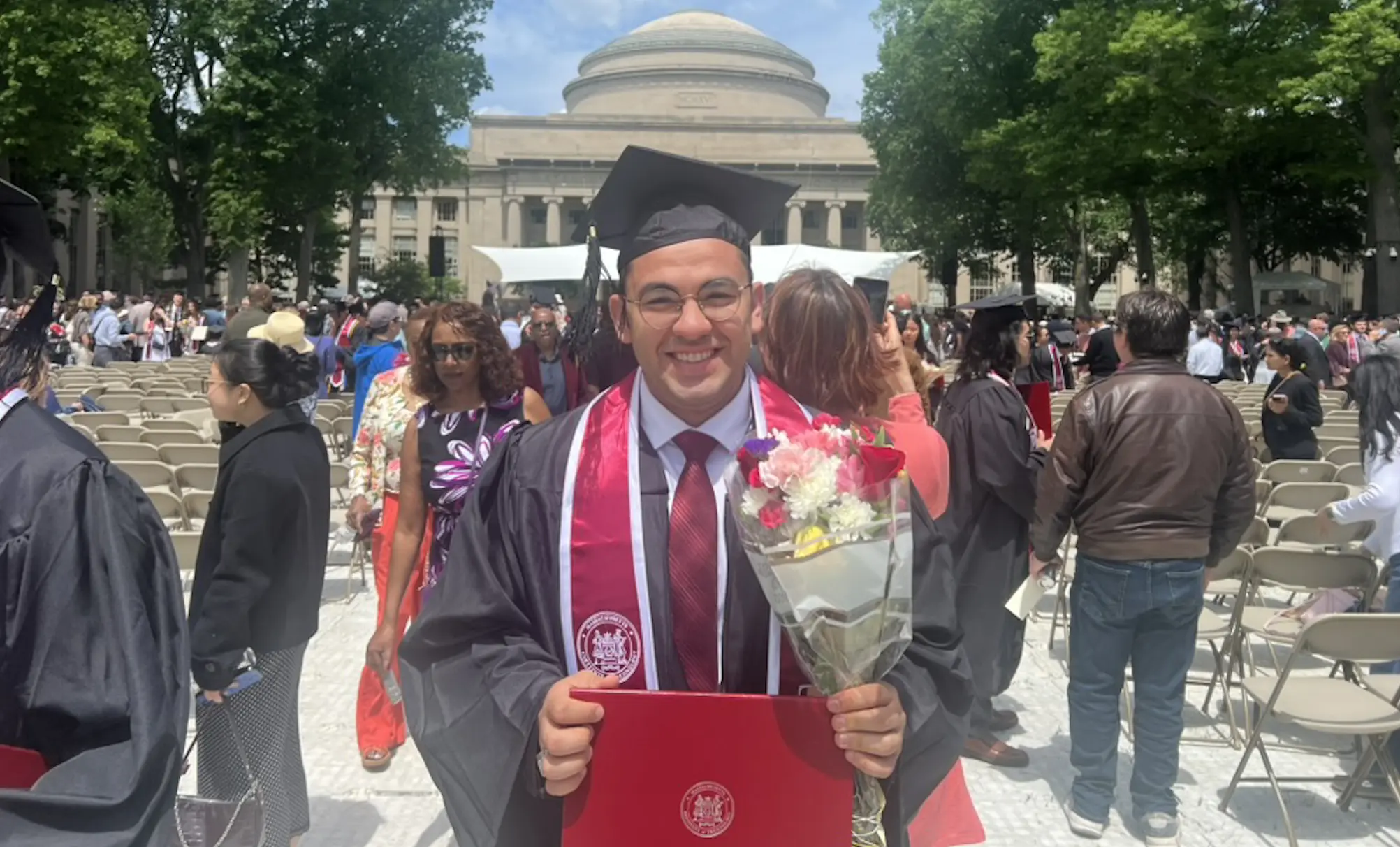
Subhi Abo Rdan graduated from MIT this spring with a double major in Computer Science and Engineering and in Physics, a grade point average of 4.7 out of 5.0, and not a single failed or incomplete course across four years. In his final year, he completed original research, now published on arXiv. He also skated with the MIT Ice Hockey Club, which he picked up alongside a course load most students carry one major at a time.
He is spending this summer as an FPGA engineer at Optiver, building hardware for high-frequency trading systems, where the difference between a good design and a great one is measured in nanoseconds. In the fall, he returns to MIT to begin a master's in quantum computing and information science, a field that sits, as he points out, exactly where his two majors meet.
He describes the pace as demanding but energizing: full days at the internship, evenings spent preparing for the shift from coursework to graduate research.
The road to MIT
Subhi grew up in Syria, where he earned a place on the national Physics Olympiad team and competed internationally. He came home with bronze medals from the International Physics Olympiad in 2020 and 2021, and from the European Physics Olympiad in both those years. He has since gone back to the program as a coach, training the students who will take those seats after him.
He was also working. Subhi lost his father during the war, and from middle school onward, Subhi held jobs alongside his studies to help support his family. In whatever hours remained, he watched MIT lectures online. "Sometimes, when I'm sitting in a lecture, I realize, oh my God, I'm actually at MIT," he said. "It makes me really happy."
MIT admitted him with a scholarship covering tuition. That still left the cost of living in one of the most expensive cities in the United States, the travel, and the money his family at home depended on. Without a way to cover those, the offer letter would have been a problem rather than an answer.
That is where Jusoor's Open Call scholarship came in.
"Jusoor supported me with all my travel and personal expenses, so I don't have to worry," Subhi said. "Now, I can focus on my dreams, my studies, and supporting my family at the same time."
At MIT, He was recognised through the George C. Newton Laboratory Award from the MIT EECS Department, awarded in May 2024. He was also actively involved in MIT’s academic and research community. He worked as an Undergraduate Teaching Assistant and previously as an Undergraduate Lab Assistant for the Digital Systems Laboratory in Fall 2025. And prior to that, he also worked as a Research Assistant at MIT’s Space Telecommunications, Astronomy and Radiation Laboratory for more than a year in 2024.
From Apple's silicon lab to the trading floor
Last summer, between May and August 2025, Subhi worked at Apple's headquarters in Cupertino as a silicon prototyping engineering intern. The work was hardware validation, the high-stakes stage where chip designs are tested before anything is manufactured.
He built a non-invasive distributed clock monitoring system for multi-board FPGA setups, allowing engineers to measure and verify external clock frequencies in real time through a register-mapped interface. He engineered a cycle-accurate validation engine that replayed RTL waveforms to emulate the wider system, making high-throughput testing of devices under test possible. And he designed a combined software and hardware pipeline to parse and compress dense engineering data, hitting a compression ratio of roughly 220 to one, which cut the time required to run a full validation cycle substantially.
The Optiver internship this summer draws on the same expertise from a different angle. Trading firms build custom hardware because general-purpose processors are too slow for the decisions they need to make, and FPGA engineers are the people who make that possible.
What comes next
The master's in quantum computing and information science is a deliberate choice rather than a natural next rung. Quantum information sits at the seam between physics and computer science, and Subhi has spent four years accumulating the depth in both that the field requires. Few students arrive at it holding degrees in each.
For him, though, the value of MIT was never only the coursework.
"Being around future world leaders and brilliant professors changes your mindset," he said. "You grow not just in knowledge, but as a person."
Jusoor's Open Call scholarship exists for students in exactly Subhi's position: admitted on merit to universities that recognize their ability, and blocked by costs that have nothing to do with it. His graduation this spring is the outcome that the program is built to produce, and in his case it is only the midpoint of the story.
.webp)


