.webp)
A wealth of information exists out there on scholarship opportunities, who is eligible, what documents matter, and how to write a strong motivation letter. However, not everyone knows where to look, what information is valuable, and how profiles are evaluated. Most importantly, this information is not always available to the specific contexts young Syrians operate in.
This is where our project ‘Bridging the Educational Opportunity Gap in Syria Through Girls Mentorship Initiative’ came in to address this gap. From August 11 to 13, 2026, Jusoor and Sanad Youth for Development ran a three-day workshop with twelve undergraduate students.
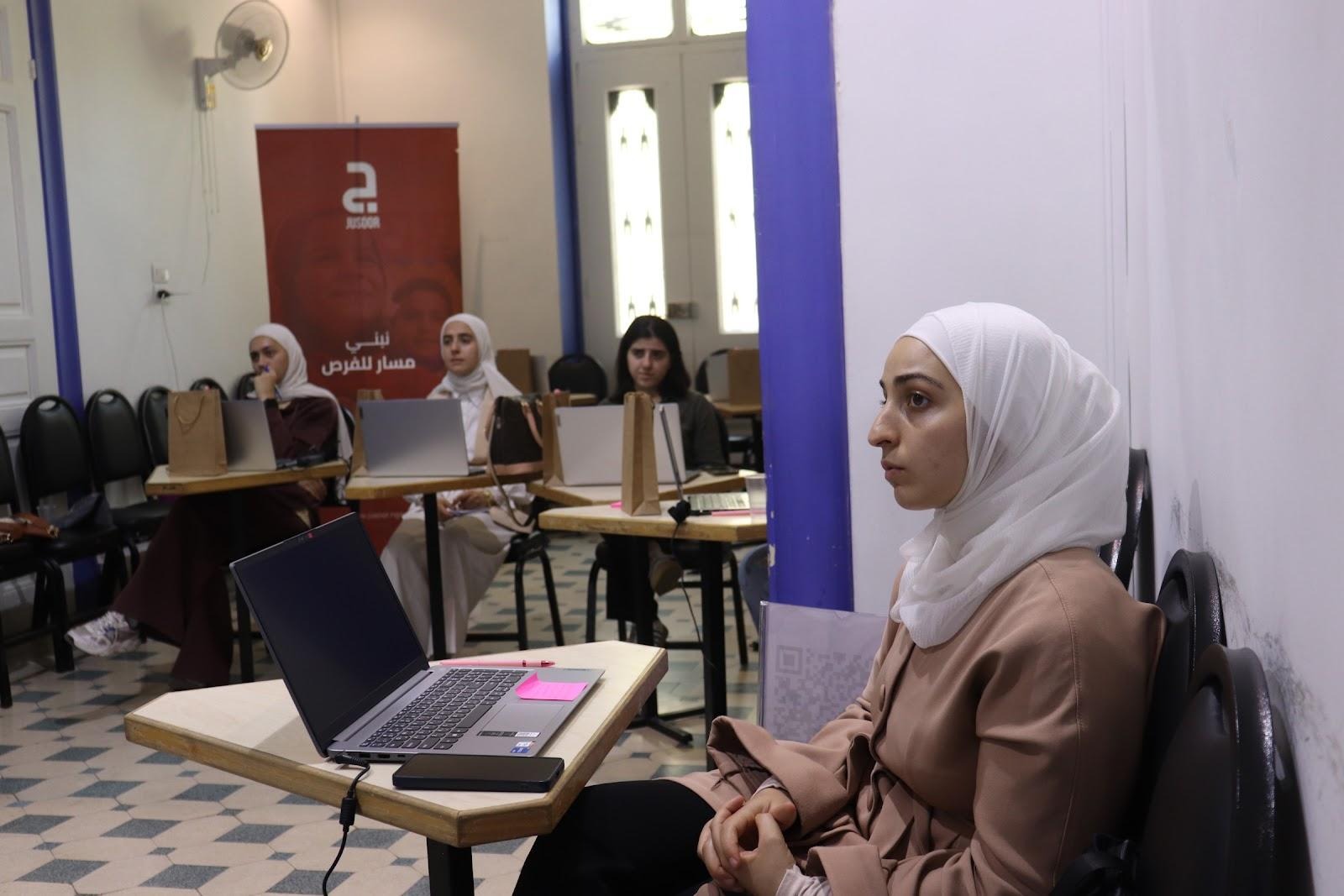
Eight girls in Syria and four in Jordan took part. Sessions ran from 3:00 to 7:00 p.m. on each of the three days, delivered remotely to participants in Jordan and in person in Syria, where students gathered at the Sanad Center in Al-Afif.
The initiative was designed and facilitated by Sally Askalan, a Jordanian chemical engineering student at Case Western Reserve University. Having lived in Jordan, India, the United States, and Germany in pursuit of her own education, she has direct experience of how much access to opportunity can change, and how much of that access comes down to information. She proposed the initiative to Jusoor and oversaw its design, content, remote delivery, and mentorship.
The three days involved sessions on researching scholarships, understanding eligibility criteria, drafting personal statements, and working through individualized feedback. Each participant left with an individual action plan.
As part of the workshop’s resources, the students made use of the 11 laptops Jusoor provided at Sanad’s Youth Space to research and write their application drafts. The laptops are available throughout the year, during the space’s opening hours, for any students wishing to use the laptops for scholarship search, applications, taking online courses, or working on any projects can do so through a reservation system at Sanad during the space’s opening hours.
Participants’ feedback
Participant evaluations were strongly positive, with satisfaction rated between four and five out of five.
More useful than the scores was where participants said the value sat. The highest-rated components were the one-on-one advising sessions, the practical work of building a CV, and the line-by-line refinement of personal statements. Participants reported real movement in their ability to research opportunities independently, organize a professional CV, and structure a personal statement that says what they mean it to say.
The CV development wasn't part of the original design. It emerged as participants worked, and ended up among the most valued things they took away, a reminder that a pilot's job is partly to find out what the cohort actually needs.
Participants are now drafting personal statements, applying to universities, preparing for English requirements and scheduling follow-up mentorship. ”After the workshop, I now have a clear path on which scholarships I’m applying for and how to approach them,” one of the participants said in her evaluation.
This is exactly the kind of support that brings Jusoor’s mission to life: helping young people navigate the barriers to higher education and turn their ambitions into real opportunities. Finally, the workshop tied the real need we saw on the ground for guidance on university applications and the barriers that exist between the ambitions of youth and their potential.